Our Lab Attends ESSERC 2026
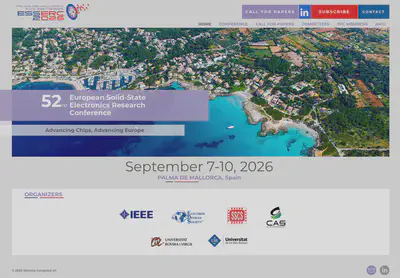
Members of our lab recently attended the 52nd European Solid-State Electronics Research Conference (ESSERC 2026) in Palma de Mallorca, Spain. The conference brought together researchers working across solid-state devices, integrated circuits, and systems. For us, it was an opportunity to learn from new work and to reflect on how chip design can address practical needs.
The Sensing for Robotics tutorial offered several examples of semiconductor research connected to European industry. Infineon discussed how motor drives, control, and force, position, and tactile feedback can be brought together in humanoid actuators. Melexis presented force and torque sensing for motion control and dexterous manipulation. These talks showed that the value of an analog chip lies not only in its individual performance metrics, but also in how well it works with sensors, mechanics, and control systems to solve a real problem.
During the conference, we also met with the president of Muse Semiconductor to explore possible collaboration on future tapeouts. Our discussion covered technical support, tapeout services, and access to different process nodes—potentially giving the lab more options for validating its designs. The conversation was exploratory; no collaboration has yet been formalized.

At one point, we joked, “Time is running out.” The Muse president replied that a Muse company should be paired with the band Muse to make the collaboration work even better. It was a light-hearted moment in an otherwise practical conversation about schedules and tapeout support.

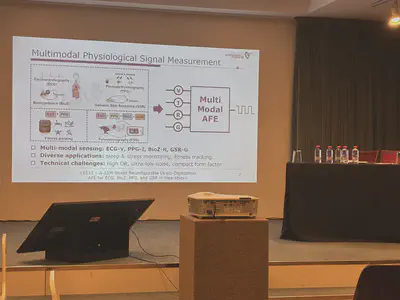
We also listened closely to Professor Jiawei Xu’s team from Fudan University present its work on wearable biomedical sensing front ends, and to a bidirectional neural-interface SoC presented by researchers including Xiongfei Jiang and Yuntao Han from the University of Edinburgh. Their work addressed challenges ranging from multimodal physiological-signal readout to neural recording, stimulation-artifact removal, and spike sorting. These reports gave us useful perspectives on the biomedical sensing and neural-interface questions that our lab is pursuing.
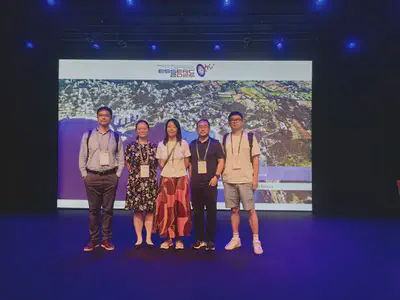
The conference also gave us the pleasure of meeting and taking photographs with Professor Qinwen Fan of Delft University of Technology, Professor Zili Yu of Heidelberg University, Professor Qiang Li of Hamburg University of Technology, Professor Jiawei Xu of Fudan University, and Dr. Yang Zhang, Principal Scientist at imec. Conversations with these experienced researchers reminded us that strong circuit work begins with sustained attention to a worthwhile problem—and depends on careful validation and collaboration across disciplines.
At the end of the trip, we visited the coast and looked out toward the open sea. The familiar saying, “There is a path through the mountain of books for those who work diligently; the sea of learning has no shore for those willing to make the journey,” felt especially apt. There is much more for us to learn, and meaningful research takes patience. We will keep learning from our colleagues and predecessors, and continue working toward biomedical sensing and analog/mixed-signal chips that address important problems and stand up to careful testing.