Qiuyang Lin Delivered an Oral Presentation at VLSI Symposium
Recently, Dr. Qiuyang Lin delivered an oral presentation at the 2026 IEEE Symposium on VLSI Technology and Circuits, presenting the team’s latest research progress on solid-state nanopore sequencing interface chips.
The work, titled “A 16-channel 97pArms 1MHz Bandwidth IC for Solid State Nanopore Sequencing”, targets next-generation high-throughput, parallelized single-molecule detection and DNA sequencing systems. It presents a 16-channel fully integrated nanopore interface chip, achieving a unified design with high gain, wide bandwidth, low noise, and high energy efficiency.
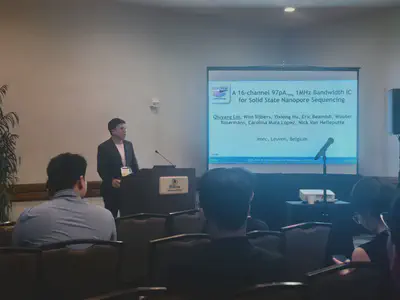
During the presentation, the audience raised many insightful questions regarding the chip architecture, noise sources, bandwidth extension, equalizer design, and system-level applications. One of the most impressive questions was:
Why does the equalizer need to provide approximately 16× high-frequency gain, and why does the noise not become dominant?
In response, Dr. Lin explained that in solid-state nanopore readout systems, the input parasitic capacitance significantly affects the high-frequency response. As a result, fast transient signals can be easily buried by high-frequency noise and front-end bandwidth limitations introduced by the input parasitic capacitance. Therefore, the role of the equalizer is not simply to amplify noise, but rather to compensate for the attenuated high-frequency components of the target signal, enabling effective transient signal detection within a 1MHz bandwidth.
This presentation highlighted the team’s continuous efforts in the following research directions:
- Solid-state nanopore sequencing interface chips
- Low-noise wide-bandwidth analog front-ends
- High-performance analog and mixed-signal integrated circuits
- Biomedical sensing interface circuits
- High-throughput molecular detection electronics

During the symposium, the team also took a short outdoor trip in Hawaii. The combination of scientific exploration and natural scenery serves as a reminder that cutting-edge chip design requires not only long-term dedication, but also openness, resilience, and curiosity.
Looking ahead, the team will continue to deepen its research in biomedical integrated circuits, neural interface chips, solid-state nanopore readout chips, and low-noise analog/mixed-signal systems, advancing high-performance chip design for life science and healthcare applications.